
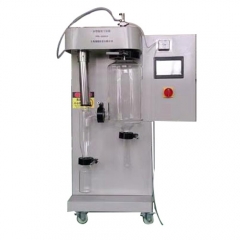
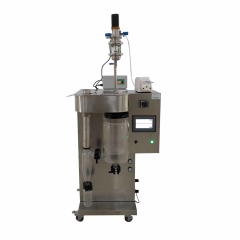
High quality 1.5L scale lab spray dryer equipment
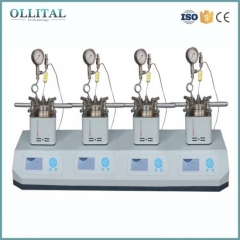
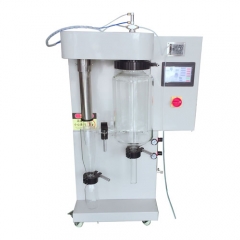
Lab scale spray dryer is suitable for the production of in universities, research institutes and food and pharmaceutical chemical enterprises.
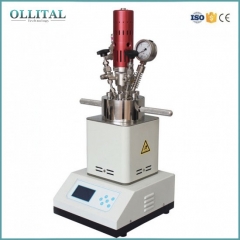
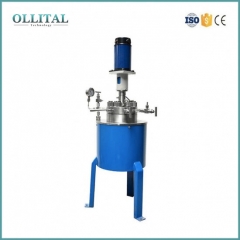
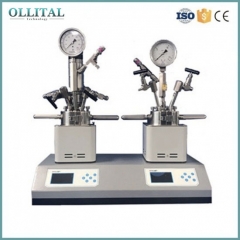
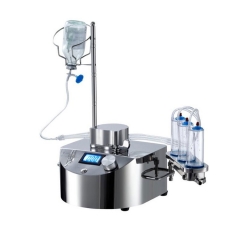
Customers working on new powder products frequently ask one key question:“I’m working with a liquid feed formulation. Should I invest in a laboratory spray dryer first, or jump directly to an industrialgrade unit?”The decision rarely hinges on the hardware itself. It mostly comes down to how much you already understand about your material and its drying behaviour.
If your formulation has never undergone spraydrying trials, smallscale laboratory testing is almost always the more pragmatic first step.The laboratory spray dryer lets you run trials with minimal feed material. You can verify atomization performance, observe powder characteristics throughout drying, and lock in workable inlet and outlet temperature setpoints to hit your target product quality.For highvalue or scarce raw materials, labscale runs also cut down on costly material waste. The core objective at this phase is to map out your material’s drying profile, before committing capital to larger productionoriented equipment.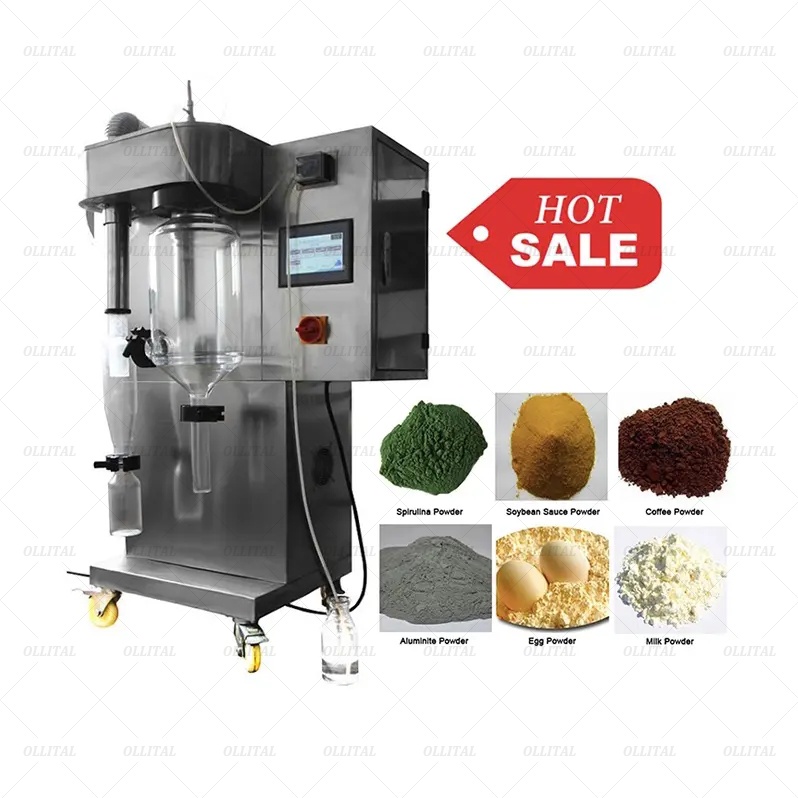
Fullsize industrial production lines are not mandatory for every project.
The pilotscale spray dryer works well for university labs, R&D departments, lowvolume batch manufacturing, and intermediatestage process validation. It delivers higher throughput than benchtop lab equipment while maintaining a compact footprint.
For businesses still refining their product formula, it serves as a practical bridge between earlystage R&D and full commercial manufacturing.
Once you have completed process validation and your target output is welldefined, an industrial spray dryer becomes a viable option. At this stage, your focus shifts to productionoriented parameters:
• Daily powder output requirement
• Continuous feed flow rate
• Solid content of your starting liquid feed
• Target residual moisture content
• Heatsensitivity of your compound
• Desired powder morphology and particle properties
These parameters allow engineering teams to calculate required evaporation capacity and configure the complete spraydrying system accordingly.
Sizing should never be based solely on target throughput. Two projects with identical daily powder output of, for example, 100 kg can end up with vastly different system requirements. Differences in feed solid fraction, viscosity, thermal sensitivity, and final powder specifications will drive distinct equipment configurations.
Material properties are therefore the true foundation for spray dryer selection.
For most newproduct development workflows, the most riskaverse path follows this sequence: Laboratory screening → Process optimisation → Scaleup validation → Full commercial production
Benchtop lab or pilot spray dryers help you lock in stable drying parameters. Only after generating solid, repeatable process data should you move to larger production hardware.Even if your end goal is highvolume commercial manufacture, there is no benefit in purchasing maximumsize equipment from day one. Characterise your material, collect reliable process data, then match your hardware to realworld production demands.
If you are developing a liquid formulation and uncertain which spray dryer fits your workflow, start with your material, not equipment specifications.Key inputs including feed concentration, viscosity, thermal sensitivity, target residual moisture, and projected production volume will rapidly narrow down your optimal solution.
At OLLITAL, our product portfolio covers laboratory spray dryers, pilot spray dryers and fullscale industrial spray dryers, supporting every phase from R&D through to commercial manufacturing.The best spray dryer is not necessarily the largest one. It is the one optimised for your unique process.



 un service en ligne
 +86 15960821529
 kevin@ollital.comkevinollital@gmail.com
 +86 15960821529
 +8615960821529


