
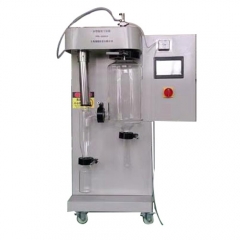
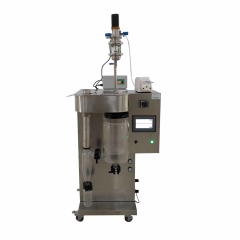
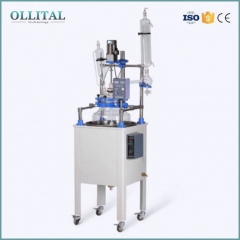
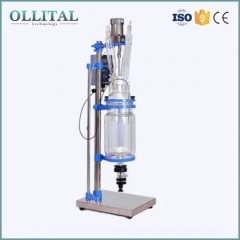
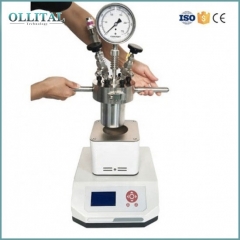
High quality 1.5L scale lab spray dryer equipment

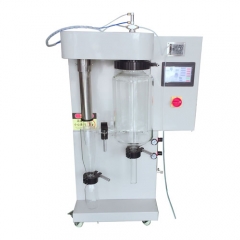
Lab scale spray dryer is suitable for the production of in universities, research institutes and food and pharmaceutical chemical enterprises.
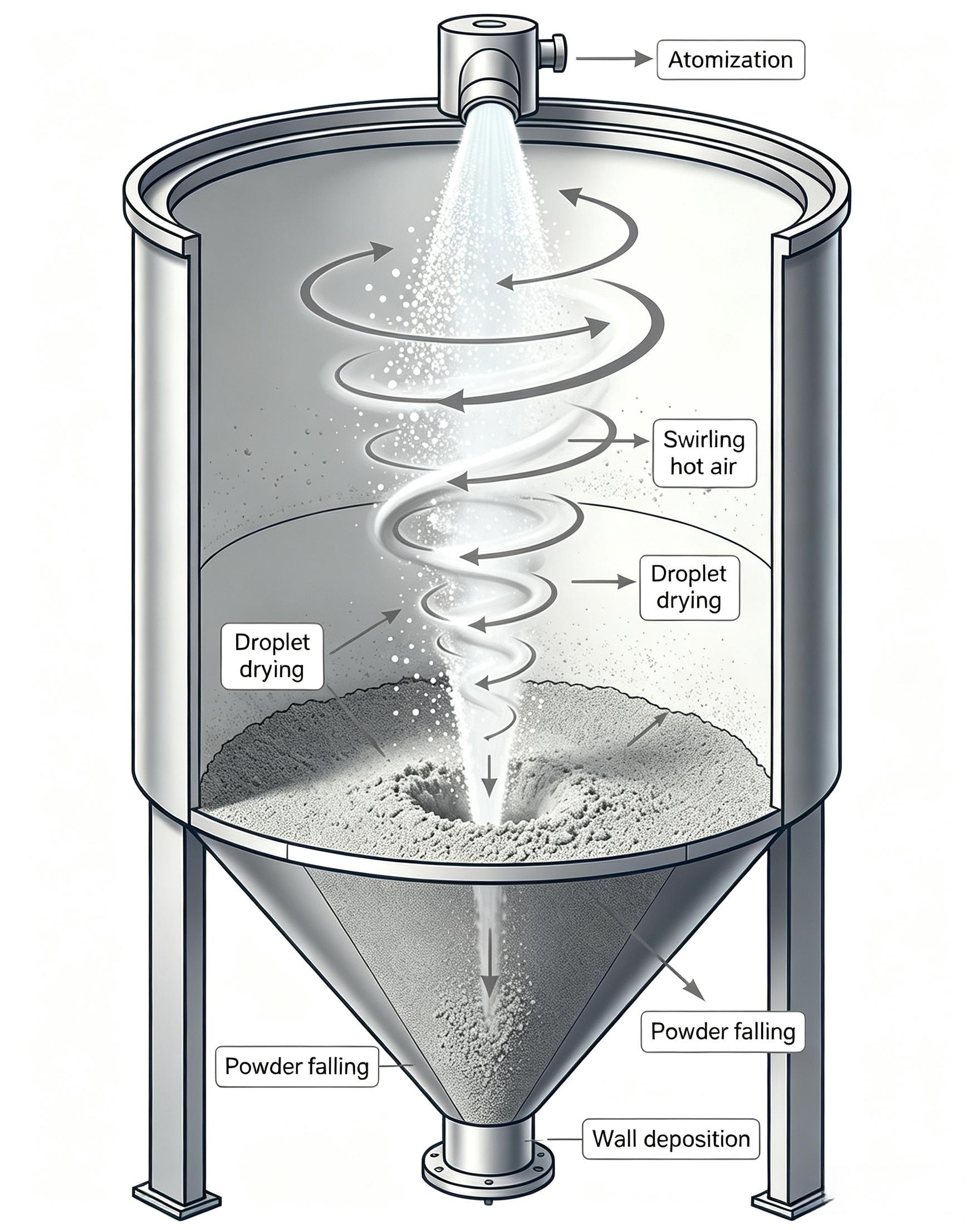
One of the most frustrating problems during spray drying is seeing a large amount of powder stuck to the wall of the drying chamber.
The spray dryer may be running normally. The feed pump is working, the liquid is being atomized, and the hot air temperature looks right. Yet when the process is finished, a noticeable layer of powder is left on the chamber wall.This is a common issue when developing a new spray drying process, especially when the material has never been tested before.
And in many cases, it does not mean there is something wrong with the spray dryer machine.
Before changing the equipment settings, it is worth taking a closer look at the material itself.Some products are simply more prone to sticking during spray drying.Materials containing sugars, proteins, extracts, fats, or other low-melting components can become sticky as moisture is removed. The problem can become more obvious when the powder passes through a temperature range where its particles become soft or tacky.Feed concentration can also make a noticeable difference.
For example, a formulation at a higher solids concentration may behave very differently from the same formulation after dilution. The liquid may atomize differently, dry at a different rate, and produce particles with different moisture content and physical properties.
This is one reason why a drying condition that works well for one product cannot always be copied directly to another.
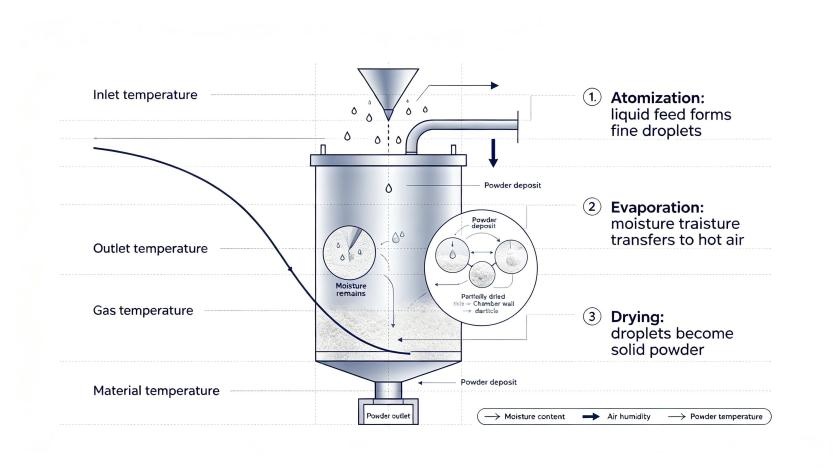
When powder starts sticking to the chamber wall, increasing the inlet temperature is often the first adjustment people consider.Sometimes it helps. Sometimes it makes the problem worse.The inlet temperature affects how quickly moisture is removed from the droplets, while the outlet temperature gives a useful indication of the thermal condition of the drying process as the particles leave the chamber.If droplets do not dry quickly enough, they may reach the chamber wall while they are still carrying too much moisture. Wet or partially dried particles are much more likely to stick.
On the other hand, some formulations become more sticky when exposed to higher temperatures.So there is no simple rule that says:
“More temperature = less sticking.”
The right drying condition depends on the material and the target powder.
There is no single setting that works for every formulation. A practical troubleshooting process is to check the main variables one by one.
Wall sticking is certainly frustrating, particularly when the collected powder is much less than expected.But it can also be useful information.
For example, significant deposits may indicate that:
In other words, the powder on the wall is not necessarily just a cleaning problem. It can tell you something about what is happening inside the drying chamber.
At OLLITAL, spray drying projects are normally considered from both the material and equipment sides.The required system can depend on the material properties, expected powder characteristics, processing capacity and preferred atomization method.For some materials, adjusting the operating conditions is enough to improve powder recovery. For more difficult formulations, the solution may involve changes to the atomization system, airflow, chamber design or powder separation system.This is also why testing is particularly useful when developing a new product.
Rather than asking only:
“Should we increase the temperature?”
it is often more useful to ask:
“Why is this particular powder sticking to the wall?”
Once the reason is understood, it becomes much easier to decide what needs to be changed.In spray drying, the final result is rarely determined by one parameter alone. It is the interaction between the material, droplets, airflow and drying conditions that ultimately determines how the powder behaves.And sometimes, the powder stuck on the wall is the first clue that helps you understand the process.



 un service en ligne
 +86 15960821529
 kevin@ollital.comkevinollital@gmail.com
 +86 15960821529
 +8615960821529


